

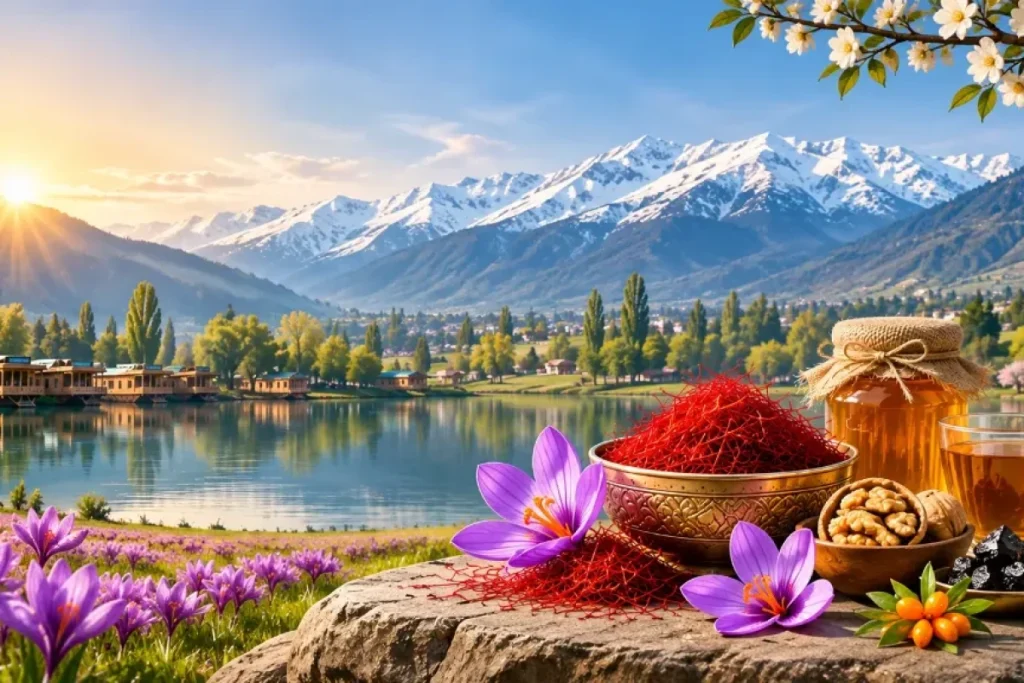
Girdled by the towering snow-clad ramparts of the Himalayas and the Pir Panjal, the valley of Kashmir has been hailed for millennia as an earthly paradise. Beyond its poetic lakes, chinar trees, and alpine meadows lies an agricultural ecosystem of unmatched biological richness. From the saffron plateaus of Pampore to the walnut forests of Kupwara and the single-clove garlic hills of Kishtwar, the geographic purity of Kashmir produces botanicals that simply cannot be duplicated anywhere else on Earth.
Key Takeaways
- Kashmir’s isolated geography and unique Karewa soils provide a mineral-dense foundation found nowhere else.
- High-altitude UV exposure and crisp mountain air stimulate plants to synthesize dense concentrations of protective secondary metabolites.
- Geographical Indication (GI) tags protect authentic Kashmiri botanicals against mass-produced commercial counterfeits.
- Generational cultivators practice sustainable, chemical-free agriculture rooted in respect for seasonal rhythms.
The Unique Geographic Gift of the Kashmir Basin
Geologically, the valley of Kashmir is an elevated oval basin situated between 5,200 and 7,500 feet above sea level. This topography shields the valley from the tropical monsoon deluges that affect the Indian plains, creating a temperate, sub-Mediterranean microclimate marked by four distinct seasons:
- Sont (Spring): Fresh snowmelt feeds rivers, awakening wild white Acacia blossoms, yellow mustard fields, and emerging Morel mushrooms.
- Grishm (Summer): Long days of intense mountain sunshine allow high-altitude crops to synthesize sugars and complex oils.
- Harud (Autumn): The great harvest season—walnuts drop from ancient groves, and purple saffron flowers carpet the plateaus.
- Wandh & Chillai Kalan (Winter): Deep freezing dormancy that concentrates tree nutrients and allows soil restoration.
The Significance of Geographical Indication (GI)
In global trade, a Geographical Indication (GI) tag identifies a product as originating in a specific territory where a particular quality, reputation, or characteristic is essentially attributable to its geographic origin. Kashmiri Saffron proudly holds prestigious GI certification, confirming its unique biological signature:
High levels of active crocin (color), safranal (aroma), and picrocrocin (flavor) distinguish genuine Kashmiri Mongra from cheap imported substitutes. Similar geographical superiority defines Kashmiri Snow Walnuts, Single-Clove Mountain Garlic, and Wild Forest Honey.
Generational Stewardship & Ethical Sourcing
At YAFFA, we believe that true luxury lies in unadulterated authenticity. We bypass industrial supply-chain aggregators and work directly with generational family cultivators across Bhaderwah, Pampore, and high valley orchards.
By guaranteeing fair compensation and supporting traditional regenerative farming methods, we ensure that the fragile mountain environment is preserved for generations to come, while delivering the purest valley treasures directly to your home.
Rooted in Kashmir. Made for Mindful Living.
Discover the complete YAFFA collection of pure Kashmiri saffron, honey, walnuts, and Himalayan wellness botanicals.
Frequently Asked Questions
What makes Himalayan botanicals more potent than lowland crops?
High altitude subjects plants to colder temperatures, rocky mineral soils, and higher ultraviolet radiation. To protect themselves, plants produce higher concentrations of protective antioxidants, polyphenols, and essential oils, resulting in superior botanical potency.
How does YAFFA verify the authenticity of its ingredients?
Every batch of YAFFA botanicals is traced to its valley harvest origin, tested for moisture, purity, and active compounds, and packaged in protective food-grade materials to safeguard freshness.
Where is YAFFA based?
YAFFA is rooted in picturesque Bhaderwah, Jammu & Kashmir, drawing inspiration from generational mountain farming traditions and pristine Himalayan purity.